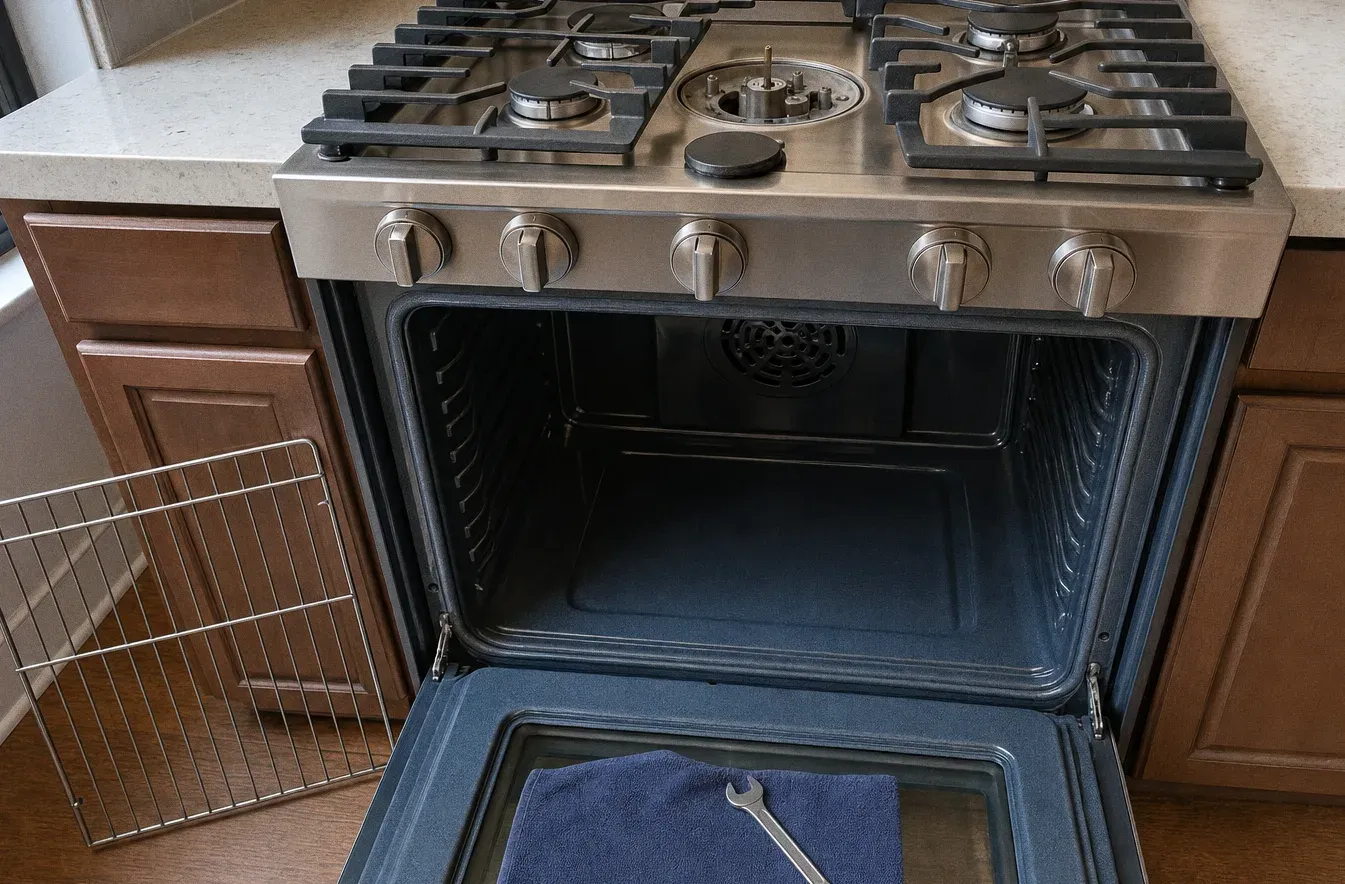
Why a Boston Wolf Oven Keeps the Door Shut After Self-Clean
A Wolf door stays latched until the control sees the cavity cool below its release threshold, so most locked doors are simply early. If the display is dead or the door is still shut long after everything is cold, the latch or a thermal fuse is the suspect.
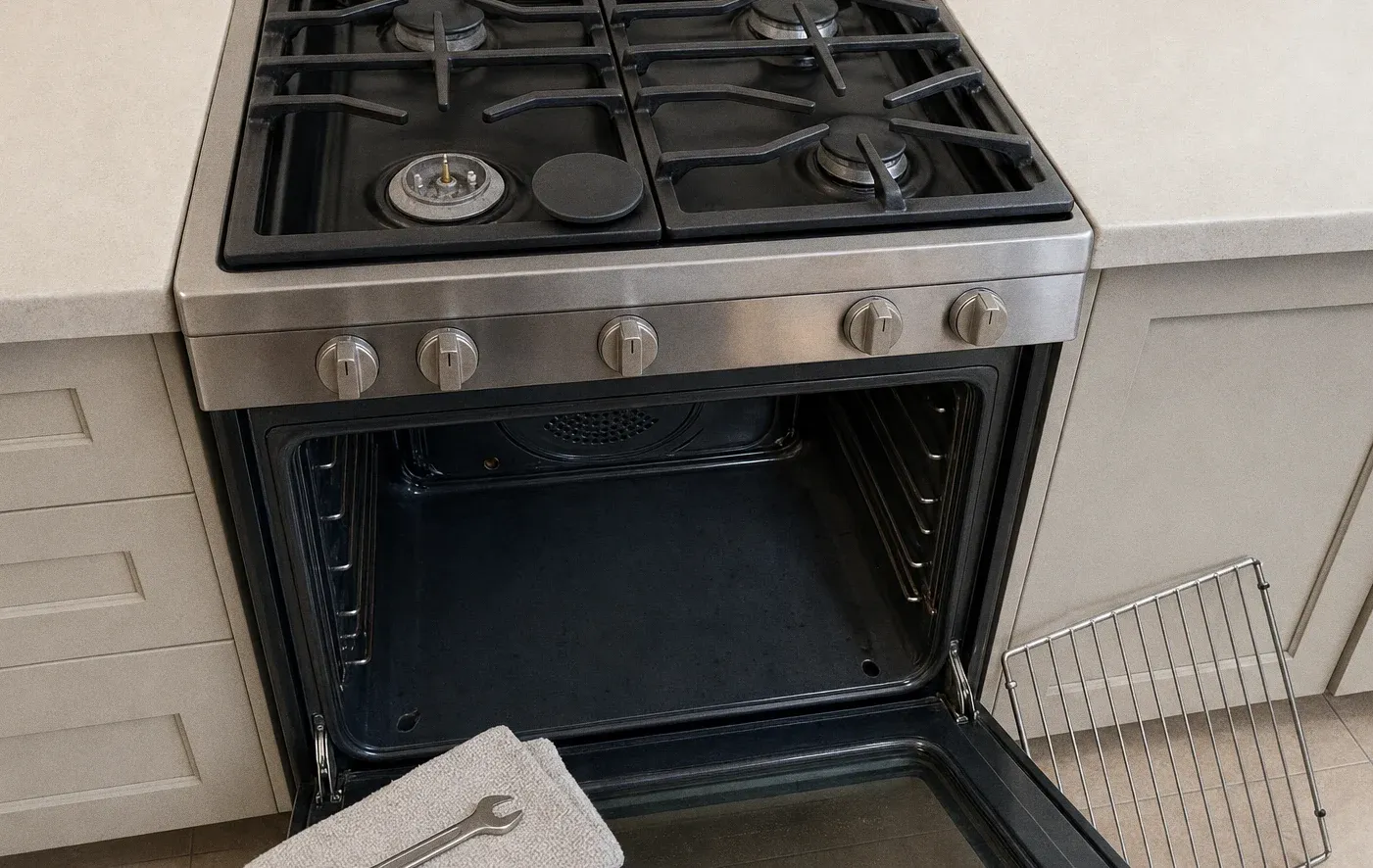
The cycle finished, the kitchen has stopped smelling of it, the front of the appliance is cool to the hand — and the door will not open. It is an alarming position to be in, particularly the evening before you need it. It is also, most of the time, an appliance doing exactly what it was designed to do.
First: how long is it supposed to stay locked?
The door does not unlock when the cleaning stops. It unlocks when the control sees the cavity fall below the temperature it releases at, and that happens a long way after the heat has been switched off. The last hour of the cycle is cool-down, and the appliance treats it as part of the programme.
From the kitchen, a normal cool-down looks like nothing at all. The display may show a countdown, a lock symbol, or simply the fact that a cycle is still in progress. A cooling fan may run for a long time after the heat has stopped, and hearing it is a good sign rather than a bad one. The outside of the door tells you very little, because a well-insulated door is meant to stay cool while the cavity behind it is not.
While you wait, watch three things: whether the display is lit and responsive, whether the fan is running, and whether any code appears. Those three answer most of what follows. Take the release timing from the guide for your own series rather than a figure someone quoted for a different one.
Waiting stops being the answer once everything is genuinely cold — cavity, vent, the glass itself — and the door is still shut. At that point something is not releasing, and more patience will not change it.
In a Beacon Hill garden-level kitchen at the bottom of a narrow stair, this is worth planning around rather than discovering. Self-clean is a long programme and the lock outlasts it, so running one the day before people arrive is how a manageable fault becomes an emergency.
A blank display changes the diagnosis
There are two very different faults hiding behind the same closed door. In the first, the appliance is alive, knows the door is locked, and is refusing to release it. In the second, the appliance has lost power altogether, and the door is shut because nothing is there to command otherwise.
A lit display, a countdown, an error code, a fan — all of those mean the control is running. A dead display means the question is now electrical, and the first place to look is the breaker panel.
Switching the breaker off and back on once is a reasonable test. It tells you whether the control will come back, and sometimes it clears a latch state. Doing it repeatedly is not a plan. If power keeps disappearing, something is interrupting it deliberately, and the usual candidate is a thermal fuse — a one-shot safety device that opens permanently when it sees a temperature it was fitted to prevent. It cannot be reset, only replaced, and a blown one is not a malfunction. It is the appliance protecting itself, and it means something ran hotter than it should have.
Self-clean is the cycle that finds these. It takes the cavity far above anything cooking asks of it, which is why a component that was marginal for years chooses that afternoon to fail.
Motor, switch, and a control that wants agreement
The latch is less mysterious than it feels. A small motor drives a bolt across the door, a switch reports the bolt’s position back to the control, and the control refuses to declare the door open until the reported position agrees with what it commanded. Three parts, one conversation, and any one of them can end it.
That produces two distinct failures that look identical from the kitchen. In the first, the motor never moves — you hear nothing when release should happen, and the bolt stays where it is. In the second, the bolt moves perfectly well but the switch does not report it, so the control keeps waiting for a confirmation that never arrives and holds everything where it is.
There is a third, more mechanical possibility. The latch assembly sits in the hottest part of the structure. Heat cycling distorts metal slightly, spilled sugar carbonises into something like glue, and a bolt that has always travelled freely can bind against a frame that has moved a fraction.
You cannot pursue any of that from the front. Reaching the latch means opening the top of the appliance or removing the control housing on a high-current circuit, and on a built-in that has to be drawn out of the cabinetry first. Where that is the answer, the Wolf Oven Repair page is the right next step.
Once the door opens, check these
Getting the door open is not always the end. Heat that stresses a latch stresses everything else too, and the cycle that provoked one fault frequently provoked a second that only shows up the next time you cook.
Run the appliance up to a moderate temperature before you need it and see whether it behaves. Bake and broil elements fail in the hours after a clean cycle more often than at any other time, and so do the control relays that switch them — an element that reaches temperature but takes far longer than it used to, or a cavity that will not hold a setting, both belong to this pattern. Door seals suffer too: a gasket that has hardened or shrunk will not seal against the frame, and the symptom is a door that no longer pulls shut properly against it.
Ash and pale residue on the cavity floor are normal after a clean cycle and wipe out with a damp cloth once everything is cold. Flaking porcelain and a discoloured patch on the glass are not, and both should be looked at rather than scrubbed.
The symptoms that end the DIY stage
Three symptoms mean stop. A smell of hot electrics or burning insulation. A breaker that trips again once you have reset it. And a door still locked well after the appliance is cold throughout.
Do not force the door. The mechanism was not built to be overridden by hand, and levering it does predictable damage to the latch assembly, the door and the frame it seats against — turning one component into three. There is no household technique for this that does not cost more than the visit.
What a visit settles is straightforward and beyond a kitchen: continuity across the thermal fuse, whether the latch motor moves when commanded, what the position switch is actually reporting, and what the control is trying to do about it. Diagnosis is $95. Where the control or its touch panel turns out to be the fault, that work generally runs between $540 and $1,600; where the outcome is the door hinge, glass or seal, it typically falls between $200 and $970. Washington Square, Beacon Hill and Jamaica Plain are all covered from here, and for the Beacon Hill and Back Bay addresses where access is a booked lift or a narrow rear stair, mention it when you call or use the booking link on this page.
Asked on the phone
Is there a safe way to lever the door open myself?
No. The bolt is driven by a motor and held by a control that has not agreed to release it, so anything you apply by hand is working against the whole assembly rather than a simple catch. The usual outcome is a bent latch, a distorted frame and a door that no longer seals — three repairs where there was one. Wait until everything is cold, then hand it over.
What does a thermal fuse do, and why would it have blown?
It is a one-shot safety device that opens permanently when it sees a temperature above what it was fitted to allow, cutting power rather than letting the appliance keep heating. It cannot be reset. A self-clean cycle drives the cavity far beyond ordinary use, so a fuse that has coped for years may finally open during one — usually alongside whatever caused the extra heat in the first place.
The door opened but now it will not heat properly. Related?
Very likely. The same heat that upset the latch also stresses elements, relays and seals, so a second fault surfacing right after a clean cycle is a pattern rather than a coincidence. Treat the two as one visit. Note what it does — slow to reach temperature, will not hold a setting, one element clearly not working — because that description narrows the diagnosis considerably.